Capulin Volcano National Monument
Fast Facts
Capulin Volcano National Monument
In the vast, high-plains landscape of northeastern New Mexico, Capulin Volcano National Monument stands as a spectacular testament to the Earth’s fiery past. This nearly perfect symmetrical cinder cone is the centerpiece of the 8,000-square-mile Raton-Clayton Volcanic Field. Extinct for roughly 60,000 years, Capulin is widely considered one of the finest and most accessible examples of a cinder cone in North America. Rising abruptly from the prairie to an elevation of 8,182 feet, the volcano offers a unique opportunity to stand on the rim of a sleeping giant and peer deep into its silent, forested crater.
The monument encompasses 793 acres of significant geological and biological resources. Capulin is not a single isolated feature but part of a larger story of volcanism that has shaped this region for over 9 million years. The landscape is a study in "scoria"—the reddish-black volcanic rock that was ejected during the volcano's brief but intense period of activity. Today, the once-barren slopes are covered in a resilient forest of pinyon pine and juniper, providing a sanctuary for diverse wildlife, including elk, mule deer, and numerous migratory birds. For the 19th-century travelers on the Santa Fe Trail, the volcano was a vital landmark, a "beacon of the plains" that signaled their progress toward the Rocky Mountains.
Visiting Capulin Volcano is an invitation to explore the "verticality" of the High Plains. Whether you are driving the 2-mile spiral road to the volcano’s summit, hiking the 1-mile loop around the rim, or watching the Milky Way arc over the dark cinder cone at night, the monument provides a profound sense of scale and perspective. It is a place where the air is thin and clear, and where the views extend across four states—New Mexico, Oklahoma, Texas, and Colorado—offering a panoramic connection to the vastness of the American West.
Key Highlights
- The Crater Rim Trail: Hike the 1-mile paved loop around the very top of the volcano, offering spectacular 360-degree views and a unique perspective into the 400-foot-deep crater.
- Volcano Road: Experience a thrilling 2-mile drive that spirals up the side of the cinder cone, gaining nearly 1,000 feet of elevation to reach the summit parking area.
- Vent Trail: Descend into the literal "heart" of the volcano on this 0.2-mile trail that takes you to the bottom of the crater where the final gas and ash were released.
- Stargazing Excellence: Enjoy some of the darkest night skies in the country at this certified International Dark Sky Park, featuring frequent ranger-led astronomy programs.
- Volcanic Geology Exhibits: Explore interactive displays in the visitor center that explain the formation of cinder cones and the Raton-Clayton Volcanic Field.
- Panoramic Views: On a clear day, see the snow-capped peaks of the Sangre de Cristo Mountains to the west and the vast grasslands of the Cimarron Cutoff to the east.
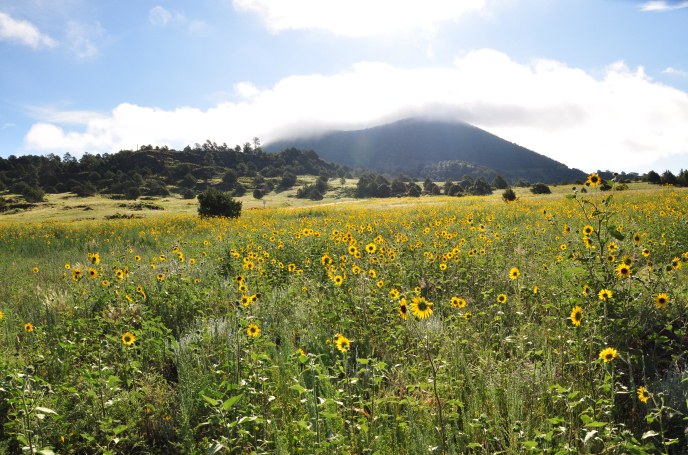
- Wildflower Displays: Witness the seasonal transformation of the volcano's base as fields of yellow sunflowers and other native plants bloom in the summer.
Getting There
Capulin Volcano National Monument is located in rural northeastern New Mexico, situated along New Mexico State Highway 325.
By Car:
- From Raton, NM (I-25): Travel approximately 33 miles east on US Highway 64/87. Turn north onto NM Highway 325 and proceed 3 miles to the monument entrance.
- From Clayton, NM: Head west on US Highway 64/87 for approximately 57 miles. Turn north onto NM Highway 325.
- From Boise City, OK: Travel west on US Highway 64/412 for approximately 110 miles.
- Main Entrance: The physical address for the visitor center is 46 Volcano Highway, Capulin, NM 88414.
Vehicle Size Restrictions: Because Volcano Road is narrow and features sharp turns and steep drop-offs, there is a maximum vehicle length of 26 feet and a width of 8 feet. This means most large RVs and trailers are not permitted on the road to the top. A large parking area is available at the visitor center for those who need to unhitch trailers.
Nearest Airports:
- Pueblo Memorial Airport (PUB): Located about 150 miles to the north in Colorado.
- Amarillo International Airport (AMA): Approximately 180 miles to the southeast in Texas.
- Albuquerque International Sunport (ABQ): Roughly a 3.5 to 4-hour drive to the southwest.
Public Transit: There is no public transportation or shuttle service to the monument. A personal or rental vehicle is necessary for your visit. The drive into northeastern New Mexico is exceptionally scenic, passing through the historic ranching country of the Cimarron Valley.
For more detailed maps and turn-by-turn directions, visit the official park directions page.
Best Time to Visit
Capulin Volcano experiences a high-altitude climate with four distinct seasons and frequent weather changes.
Spring (April - June): Spring is a season of transition. While the prairie turns green, this is also the windiest time of year in northeastern New Mexico. Temperatures are mild (50s to 70s), but late-season snowstorms can occur through May. This is a quiet time to visit before the summer season.
Summer (July - August): This is the peak visitor season. Temperatures are generally pleasant due to the 7,000-foot elevation, with highs in the 80s. However, afternoon thunderstorms are very common and can move in quickly. Because the Volcano Road and rim trail are completely exposed, lightning is a major hazard. Plan to visit early in the morning and carry water.
Fall (September - October): Many consider autumn to be the ideal time for a visit. The intense summer sun fades into crisp, clear days with temperatures in the 60s and 70s. The visibility is at its peak, providing the best long-range views of the surrounding states. The humidity is very low, making for excellent hiking.
Winter (November - March): Winter turns the volcano into a quiet, frozen landmark. Temperatures range from the 20s to the 50s. Snow is common from December through April and is the primary cause of temporary closures for the Volcano Road. On sunny winter days, the contrast of the dark scoria against the white snow is visually stunning.
Operating Hours: The Visitor Center is typically open daily from 8:30 AM to 4:30 PM. Vehicle access to the Volcano Road is restricted to specific hours (usually 8:30 AM to 4:00 PM). Pedestrians and cyclists are often allowed on the road after vehicle hours. The site is closed on Thanksgiving, Christmas, and New Year's Day.
Activities and Adventures
The monument offers a range of activities that highlight its unique geology and dark sky resources.
Driving to the Summit: Most visitors experience the park via the Volcano Road. This 2-mile drive is a feat of early engineering, spiraling upward and providing increasingly dramatic views of the volcanic field. It is a slow, scenic drive that takes about 10 minutes each way.
Hiking the Rim and Crater: The Crater Rim Trail (1 mile) is a must-do. It is a paved loop that offers the highest vantage points in the park. Though paved, it has several steep sections. The Vent Trail (0.2 miles) provides a quick descent into the crater. For a more traditional nature hike, the Lava Flow Trail (1 mile) at the base of the volcano takes you through the fields of jagged lava rock and pinyon-juniper forest.
Stargazing and Astronomy: Capulin Volcano is a certified International Dark Sky Park. The lack of light pollution in this remote corner of New Mexico allows for incredible views of the Milky Way. During the summer, rangers host frequent "Night Sky" programs using high-powered telescopes in the visitor center overflow parking lot.
Museum and Film: The visitor center features a high-quality museum with exhibits on the Raton-Clayton Volcanic Field and the archaeology of the Folsom site (located nearby). The 10-minute introductory film provides a visual overview of how Capulin was formed during its estimated 10-year period of activity.
Wildlife Watching: The volcano is a haven for birds of prey, including golden eagles and red-tailed hawks, which utilize the thermal updrafts from the crater. You might also spot black bears, elk, and wild turkeys in the lower forests. Always maintain a safe distance and store food properly.
Junior Ranger Program: Children can participate in an educational program that focuses on volcanic processes and the importance of dark skies. Completing the activities earns them a Junior Ranger badge.
History & Geology
The story of Capulin is a narrative of deep time and geological precision.
The Formation of the Cone: Capulin is a classic "cinder cone." It was formed roughly 60,000 years ago during a single eruptive event that likely lasted about 10 years. Magma rose through a vent, and as it hit the surface, gas pressure caused it to explode into small pieces of lava that cooled in mid-air, falling back to Earth as "cinders" or scoria. These cinders piled up around the vent to create the symmetrical cone we see today.
The Raton-Clayton Volcanic Field: Capulin is one of hundreds of volcanoes in this massive field. The area includes shield volcanoes, cinder cones, and lava flows that range in age from 9 million to 10,000 years old. The field is a vital site for scientists studying the movement of magma through the Earth's crust.
The Santa Fe Trail Connection: During the mid-19th century, the Cimarron Route of the Santa Fe Trail passed just south of the volcano. For the wagon trains moving between Missouri and Santa Fe, Capulin was an unmistakable landmark that helped them navigate the vast and featureless plains.
Preservation and the Antiquities Act: Capulin was established as a National Monument in 1916 by President Woodrow Wilson under the Antiquities Act. The goal was to protect its "scientific and educational interest" as one of the best-preserved cinder cones in the world. The construction of the Volcano Road in the 1920s was a pioneering effort to make geological wonders accessible to the motoring public.
Lodging and Camping
While there is no camping or lodging within the monument, the surrounding area offers several options.
In-Park Camping: Not available.
Nearby Accommodations:
- Capulin, NM: The tiny community just outside the gate has one small motel and a RV park.
- Raton, NM (33 miles west): Offers a full range of national hotel chains, historic motels, and numerous dining options.
- Clayton, NM (57 miles east): Provides local lodging and services.
State Park Alternatives: Sugarite Canyon State Park near Raton and Clayton Lake State Park near Clayton both offer developed campgrounds, fishing, and hiking.
Dining: There are no food services within the monument. The nearby village of Capulin has a small cafe (seasonal). It is highly recommended to bring a picnic lunch to enjoy at the park’s designated picnic area near the visitor center.
Essential Information
Park Fees and Passes
- Entrance Fee: $20 per private vehicle, valid for 7 days.
- Passes: Capulin Volcano accepts all "America the Beautiful" passes. The park also sells its own annual pass for $35.
Safety Considerations
- Altitude: The summit is over 8,000 feet. Visitors from lower elevations should be aware of the signs of altitude sickness, including headache and shortness of breath. Pace yourself and drink plenty of water.
- Lightning: The rim trail is the highest point in the area and is extremely vulnerable to lightning. If you hear thunder or see dark clouds approaching, leave the rim and Volcano Road immediately.
- Volcano Road Safety: The road is narrow with no guardrails in many places. Obey the 15 mph speed limit and stay in your lane. Watch for pedestrians and cyclists.
- Heat and Hydration: The high-altitude sun is intense. Carry water on all hikes, even the short rim loop.
- Historic Preservation: Help protect the volcano by not removing any scoria or lava rock. Do not climb on the loose slopes of the cone; stay on the paved trails to prevent erosion.
Services and Facilities
The Visitor Center is fully accessible and includes restrooms, a museum, and a bookstore. The Volcano Road is accessible to vehicles within the size limit. The Crater Rim Trail is paved but has significant grades that may be difficult for some wheelchairs. The Vent Trail and Lava Flow Trail are not fully wheelchair accessible.
Contact
- Phone: 575-278-2201
- Email: [email protected]
- Official site: https://www.nps.gov/cavo/index.htm
Capulin Volcano National Monument is a place of profound silence and spectacular beauty. By ascending its slopes and peering into its ancient crater, visitors can connect with the immense forces that have shaped our planet. It is a destination that rewards the curious with a unique perspective on the geological and human history of the American West.
Park Overview
Detailed overview of the park's history, geography, and main attractions will go here. This section provides essential background information for visitors.
Top Hikes
- Iconic Summit TrailDifficulty: Strenuous • Distance: 8 miles round trip
Loading reviews…
- Waterfall LoopDifficulty: Moderate • Distance: 3 miles loop
Loading reviews…
- Lakeside WalkDifficulty: Easy • Distance: 1.5 miles out & back
Loading reviews…
Recommended Hiking Gear
Gear up for your adventure with our trusted partners. These items help support the site at no extra cost to you!

Places to Stay
- Historic Park LodgeBook early!Type: Lodge
Loading reviews…
- Riverside CampgroundReservations required.Type: Campground
Loading reviews…
- Gateway Town Hotel15 miles from entrance.Type: Nearby Hotel
Loading reviews…